
Invest in Workplace English Instruction, Save on Employee Turnover: A HR Strategy With Real Returns
For every $1 invested in EnGen, employers see savings of nearly $2 from reduced turnover alone
Faced with ongoing labor shortages and a tightening economy, employers across industries are urgently seeking ways to retain talent and protect their bottom line. One powerful but often overlooked strategy is gaining momentum: English upskilling.
By investing in this innovative, workforce-focused approach to English instruction, forward-thinking companies are boosting retention and building stronger, more resilient teams from within.
Turnover isn’t just disruptive; it’s also expensive. Recruiting, hiring, onboarding, and lost productivity can cost 1.5 to 2 times an employee’s salary. Yet it is possible to address turnover costs while also investing in employee growth.
This analysis shows that workplace-based English instruction is paying for itself and more. Employers across industries are saving thousands per worker, with average returns of $1.95 for every $1 invested in EnGen.
Employer-provided English instruction can be a game-changer for companies of all sectors and sizes, particularly those who employ frontline workers in high-turnover sectors like retail, healthcare, and manufacturing. More than just a workforce benefit, English upskilling is a high-impact, data-based business investment.
What is English Upskilling?
English upskilling is an innovative workforce development solution that equips employees—particularly those in frontline roles—with language, literacy, and job-specific skills needed for success in industries like retail, manufacturing, healthcare, finance, and more.
Delivered through AI-powered, mobile-first platforms, English upskilling is flexible, scalable, and designed to meet workers where they are. EnGen’s model combines digital learning, live online workshops, personalized coaching, and industry-relevant content.
Quantifying the ROI
Our findings are based on data from EnGen learners employed at Fortune 1000 companies across industries like retail, manufacturing, healthcare, and finance.
Data indicate significant gains in retention amongst employees who are enrolled in EnGen compared to those who are not, as described below.
To calculate cost savings based on improved retention, we combined proprietary company data with publicly available data from the Bureau of Labor Statistics in the following formula:
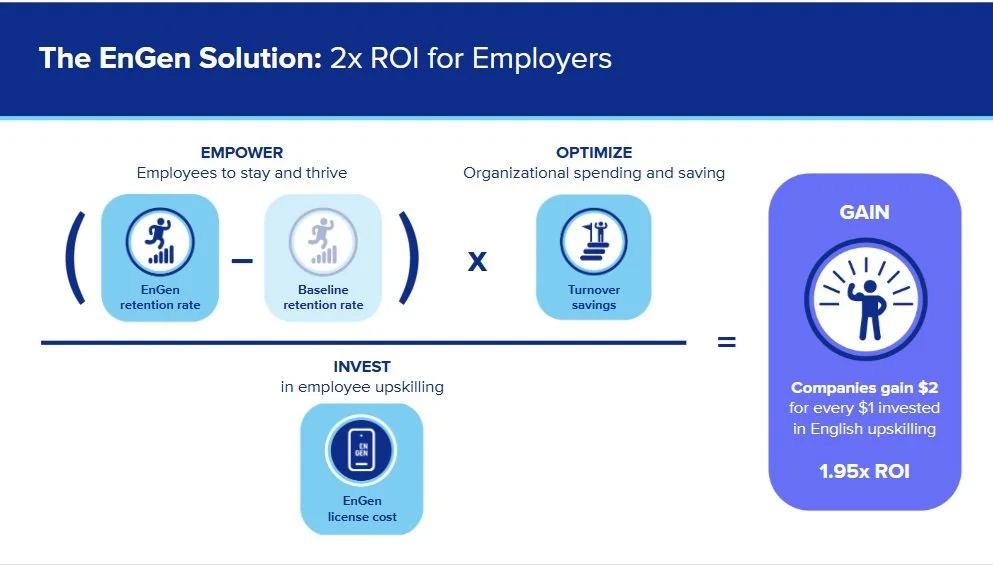
Each piece of this formula is described in detail below.
Data Analysis
Retention Improvement
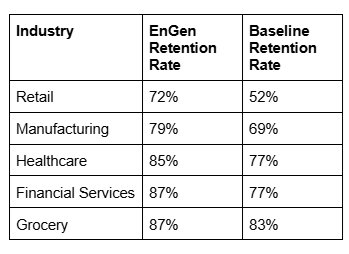
We began our analysis by comparing company-provided data on baseline retention rates—those of employees not using EnGen—with retention rates of employees who are enrolled in EnGen.
As shown in the table below, enrollment in EnGen’s workplace-based English learning benefit is associated with significantly higher retention rates across a range of industries.
Turnover Savings
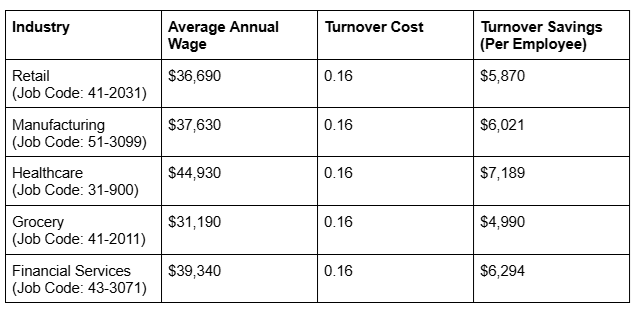
Next, we quantified the cost savings from the reduced employee turnover illustrated above. We used data from the Bureau of Labor Statistics’ Occupational Employment and Wage Statistics (OEWS) database to establish an average wage for each industry included in our analysis.
We identified a standardized turnover cost of 16% of an employee's annual wages—a number derived from a 2012 Center for American Progress study that is likely conservative when compared to more recent literature. For example, a meta-analysis from 2020 estimates turnover costs at 19.7% of annual wages for earning below the median; additional studies show that turnover costs can range from 25-35% of an employee’s annual wages to 1.5 to 2 times a worker’s salary. See citations in the References section below.
Turnover savings were calculated as follows:
Average Annual Wage × Turnover Cost (0.16) = Turnover Savings Per Employee
EnGen License Cost
EnGen offers a variety of supplemental services, including enrollment support and personalized learner coaching. Licensing fees vary based on services selected.
This analysis uses the average license cost for EnGen learners at each company to estimate the return on investment (ROI).
Return on Investment
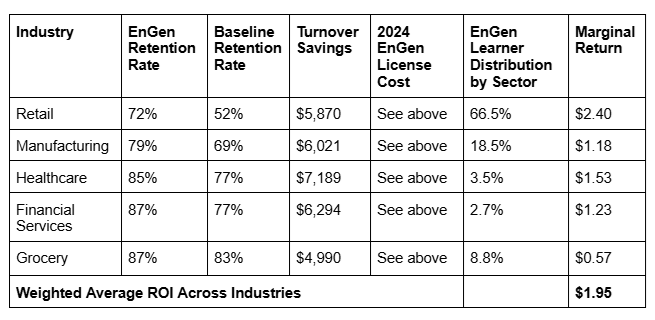
Using data inputs as described above, we calculated return on investment (ROI) to employers, using the following formula to reflect savings from improved retention:
(EnGen Retention Rate − Baseline Retention Rate) × Turnover Savings ÷ EnGen License Cost = Return on Investment
To ensure that our ROI calculations accurately reflect the employer data used in the analysis, we applied a weighted average based on the number of employees enrolled in EnGen across each industry sector. This approach gives proportionally greater influence to sectors with larger EnGen learner representation.
For example, because the retail sector accounts for the largest share of employees (66.5%), its outcomes have a stronger effect on the overall weighted average than smaller sectors. The full percentage distribution by industry is displayed in the chart below.
An HR Strategy with real returns
The numbers tell a powerful story: English upskilling doesn’t just support employees; it also saves companies real money. By boosting retention, employers across industries avoid thousands of dollars in turnover costs for every EnGen learner, far outweighing the investment costs for an EnGen license. More than a smart workforce strategy, English upskilling is a solution that pays for itself.
References
Boushey, H. and Glynn, S. J. (2012). There Are Significant Business Costs to Replacing Employees. Center for American Progress. https://www.americanprogress.org/article/there-are-significant-business-costs-to-replacing-employees/
Bahn, K. and Sanchez Cumming, C. (2020). Improving U.S. Labor Standards and the Quality of Jobs to Reduce the Costs of Employee Turnover to U.S. Companies. Washington Center for Equitable Growth. https://equitablegrowth.org/improving-u-s-labor-standards-and-the-quality-of-jobs-to-reduce-the-costs-of-employee-turnover-to-u-s-companies/
EnGen. (2024). Workforce Report: Powering Local Workforces, Building Cohesive Communities. https://getengen.com/impact-2024
EnGen,. (2025). Workforce Report: Strengthening Talent Pipelines, Driving Bottom Lines. https://getengen.com/impact-2025
HR Dive. (2017). Study: Turnover costs employers $15,000 per worker. https://www.hrdive.com/news/study-turnover-costs-employers-15000-per-worker/449142/
McFeeley, Shane and Wigert, Ben. (2019) This Fixable Problem Costs U.S. Businesses $1 Trillion. Gallup Workplace. https://www.gallup.com/workplace/247391/fixable-problem-costs-businesses-trillion.aspx
Fighting What’s Different Differently: Retention in the Grocery Frontline (CCRRC, January 2024). https://www.ccrrc.org/content/dam/ccrrc/us/en/pdf/north-america-large-store/Fighting-whats-different-differently-final.pdf.
U.S. Bureau of Labor Statistics. (2023). Job Openings and Labor Turnover Survey (JOLTS). https://www.bls.gov/jlt/
U.S. Bureau of Labor Statistics. (2023). Occupational Employment and Wage Statistics (OEWS). https://www.bls.gov/oes/